
Indian stock markets have experienced some ups and downs in the first half of 2025. However, both the Nifty 50 and Sensex saw steady gains, supported by a healthy economy and better corporate earnings. In this article, we will look at the detailed performance of these key indices and explore the sectors that drove the market rally.

The stock of India's largest listed pure-play retail company, Avenue Supermarts (DMart), has slipped over 10 per cent from its monthly highs. A weak operational performance in the fourth quarter (January-March) of financial year 2024-25 (Q4FY25) and muted near-term outlook due to intense competitive pressures and higher costs could lead to downward momentum on the stock. While the stock dipped by 3.44 per cent in early trade on Monday, it recovered a bit to close 1.07 per cent lower at 4,017.

Finance Minister Nirmala Sitharaman on Thursday proposed to borrow Rs 14.13 lakh crore by issuing dated securities to meet revenue shortfall in the next financial year starting on April 1.

Infosys was the only large-cap IT player to report sequential constant currency (cc) revenue growth for the June quarter (1 per cent ), which was ahead of analyst expectations, but the company's sharp downward revision in its growth guidance took most brokerages by surprise. In line with the cut in its FY24 revenue guidance (cc) to 1-3.5 per cent, brokerages have unanimously reduced FY24 EPS estimates for the company in the range of 2-4 per cent, though the Street is likely fearing even further downside, they say. Global brokerages Macquarie and Nomura downgraded Infosys to underperform and reduce ratings, respectively, with the latter cutting the target price to Rs 1210 from Rs 1260.

Post-election capital expenditure (capex) has been weak at 2 per cent year-on-year (Y-o-Y) in M9FY25. The FY25 revised estimates (RE) indicate 7 per cent growth in FY25 against FY24, implying 21 per cent Y-o-Y growth in Q4FY25 government capex.

In a significant policy shift aimed at boosting agri-productivity and rural prosperity, Finance Minister Nirmala Sitharaman on Saturday announced six new agricultural schemes while increasing the subsidised Kisan Credit Card loan limit to Rs 5 lakh from the existing Rs 3 lakh, benefiting 7.7 crore farmers, fishermen, and dairy farmers.

The net indirect tax collection in 2020-21 grew 12.3 per cent annually to Rs 10.71 lakh crore, thereby exceeding the target set in revised estimates, the Finance Ministry said on Tuesday. The mop-up through indirect taxes, which include GST, Customs and excise duties, was Rs 9.54 lakh crore in 2019-20. In the Revised Estimates (RE) for 2020-21, the target was set at Rs 9.89 lakh crore. Net collections from Goods and Services Tax (GST) stood at Rs 5.48 lakh crore during 2020-21, an eight per cent drop compared to Rs 5.99 lakh crore in the previous fiscal year.

The Union government is projected to share about 32 per cent of central taxes with states during the financial year 2024-25 against the 15th Finance Commission's recommendation of 41 per cent. The Revised Estimates (RE) for FY24, too, show a similar share of states in the central taxes at 32 per cent. In absolute terms, however, there has been an increase in the amount devolved to states compared to the Budget Estimates (BE) for FY24 at Rs 11 trillion.

Recent documents by NITI Aayog and periodic labour force surveys on employment show that the importance of agriculture is rising in the Indian economy.

The ministry of minority affairs informed the Lok Sabha that in 2022-2023, it had been allotted Rs 5,020.5 crore (Rs 50.20 billion); in the Revised Estimates, it had got Rs 2,612.66 crore (Rs 26.12 billion); and had spent, until the end of March this year, Rs 712.5 crore (Rs 7,12 billion).

'Nearly 10 million people will benefit from the increase in the rebate limit for those earning up to Rs 12 lakh.' 'We expect all that money will come back into the economy in either savings, consumption, or investments.'

Experts say the state's economy is grappling with hidden debt, rising welfare costs, and lack of transparency.

Reserve Bank on Wednesday cut India's growth forecast to 6.5 per cent from 6.7 per cent estimated earlier for the current financial year on account of impact of global trade and policy uncertainties. Prospects of agriculture sector remain bright on the back of healthy reservoir levels and robust crop production in 2025-26, RBI Governor Sanjay Malhotra said while unveiling the outcome of the first bi-monthly Monetary Policy Committee meeting for the current financial year.

Net direct tax collection in the eight months of the current fiscal touched 58.34 per cent of Budget Estimates (BE) at Rs 10.64 lakh crore. The net tax collection for April-November stood at Rs 10.64 lakh crore, which is 23.4 per cent higher than the corresponding period of last year, the ministry of finance said.

India's Finance Minister Nirmala Sitharaman has announced an ambitious plan to develop the country's top 50 tourist destinations in a "challenge mode", with the aim of boosting employment-led growth and attracting international visitors. The Ministry of Tourism has received a significant budget increase for 2025-2026, with a focus on enhancing tourism infrastructure, promoting domestic and international travel, and ensuring the safety of tourists, particularly women. The government plans to promote homestays, improve connectivity to tourist spots, and provide performance-linked incentives to states that demonstrate effective destination management. The budget also includes investments in public enterprises, skill development programs, and initiatives to promote medical tourism and spiritual tourism.

10 largecaps stocks which stand to gain from the Budget.

'$125 million for the hull and the remaining of over $350 million for liability.'

Maruti Suzuki India (MSIL) said on Thursday its operations are unaffected by the global rare earth magnet shortage, but added that the situation is "uncertain and evolving". The firm said it is exploring multiple solutions to maintain continuity in operations and will notify stakeholders in case of material impact.

RBI projects GDP growth in FY16 at 7.8 per cent, 30 bps higher than FY15. However, this comes with a downward bias.
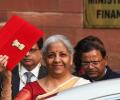
'... that it once again shies away from renewing its commitment to strategic divestment,' points out A K Bhattacharya.

Fiscal deficit would be brought down to below 4.5 per cent by 2025-26, Finance Minister Nirmala Sitharaman said on Wednesday. She also said that tax receipts for the next fiscal are budgeted at Rs 23.3 lakh crore and states would be allowed 3.5 per cent of GDP as fiscal deficit. To finance the fiscal deficit in 2023-24, net market borrowing from dated securities is estimated at Rs 11.8 lakh crore, Sitharaman said while presenting the Union Budget for 2023-24 in the Lok Sabha.

The Ministry of Statistics and Programme Implementation (MoSPI) on Friday said it has advanced the release of macroeconomic data Gross Domestic Product (GDP) estimates by about 90 mins to 4 pm. As per the current practice, the press releases of GDP are scheduled at 5.30 pm on the specified release dates, a MoSPI statement said.

The Union Budget 2025-26 on Saturday allocated Rs 2,33,210.68 crore to the Ministry of Home Affairs with the majority of the fund -- Rs 1,60,391.06 crore -- being given to central police forces like Central Reserve Police Force (CRPF), Border Security Force (BSF) and Central Industrial Security Force (CISF) which are responsible for internal security, border guarding and security of vital installations.

The government's initiative to migrate SEZ data from NSDL software to ICEGATE system for streamlined reporting of import data caused double counting of gold imports, resulting in inflated figures and the issue has now been largely rectified, government sources said. The downward revision has provided the actual picture of trade deficit (difference between imports and exports), which was earlier looking very high. The deficit for November will now be revised downwards from $37.84 billion to about $32.8 billion. Similarly, there will be a revision in overall import numbers as well.
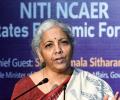
'Each state is unique, but when it comes to finance, the fundamentals cannot be different.'

Banking credit in the economy grew by 11.1 per cent year-on-year (Y-o-Y) in the fortnight ended March 7, while deposits grew at 10.2 per cent during the same period, which is a gap of around 90 basis points (bps), according to the latest data from the Reserve Bank of India (RBI).

India's economic growth accelerated to 8.4 per cent in the third quarter of 2023-24, mainly due to good performance by the manufacturing, mining & quarrying and construction sectors. The Indian economy recorded a growth of 8.4 per cent in the third quarter of this fiscal (October-December 2023), according to data released by the National Statistical Office (NSO) on Thursday.

When Nirmala Sitharaman announced her new privatisation policy, there were serious doubts if the move had the BJP's full political backing. All those doubts were dispelled when her initiatives were endorsed by Modi in Parliament, observes A K Bhattacharya.

As the poverty rates in the country declined below 5 percent in 2024, a research study by State Bank of India also highlighted that the extreme poverty in the country has been reduced to minimal.

'We are not incentivising the old tax scheme. These taxpayers will also shift to the new regime after comparison.'

A robust show during the March quarter of 2024-25 (Q4FY25) and hopes of a strong demand momentum have led to an upward revision of Mahindra & Mahindra's (M&M's) earnings. With a slew of launches lined up amid a steady demand environment, brokerages see M&M outperforming peers in passenger vehicles (PVs), tractors and commercial vehicles (CVs).

Chief Economic Advisor V Anantha Nageswaran on Thursday said economic activity in some sectors have picked up pace during October-November and a GDP growth of 6.5-7 per cent in the current fiscal is feasible.
Mumbai, which adds 37 per cent to the total direct tax mop-up, has reported tax collection of Rs 4.93 trillion so far, against the full-year target of Rs 5.35 trillion.
The Reserve Bank on Thursday marginally revised upwards the economic growth projection for the current fiscal to 6.5 per cent, from its earlier estimate of 6.4 per cent. Unveiling the first bi-monthly monetary policy of 2023-24 fiscal, RBI Governor Shaktikanta Das said the GDP growth in the first quarter of 2023-24 is expected at 7.8 per cent.

At the same time, Rs 53.32 crore is for the President's Secretariat and Rs 36.22 crore for the expenditure on the President's household establishment, including staff salaries, which includes discretionary grants of the President.

The IMF on Tuesday projected a growth rate of 6.1 per cent for India in 2023, which is a 0.2 percentage point upward revision compared with the April projection. This is reflective of the "momentum" from stronger-than-expected growth in the fourth quarter of 2022 as a result of stronger domestic investment, the International Monetary Fund (IMF) said. "Growth in India is projected at 6.1 per cent in 2023, a 0.2 percentage point upward revision compared with the April projection," it said in its latest update of the World Economic Outlook.

India's industrial production growth remains almost flat at 3 per cent in March sequentially, though, on a year-on-year basis, it slipped from 5.5 per cent, mainly due to poor performance of the manufacturing, mining and power sectors.

Havells India, the country's largest listed consumer electrical company, reported a mixed performance in the 2024-25 (FY25) October-December quarter (Q3). While the top line benefited from festival demand, lower margins impacted operational performance.

Mumbai -- home to industry titans and Bollywood stars -- is witnessing a slow offtake of houses priced between Rs 10 crore and Rs 50 crore. Industry insiders and real estate watchers explain why.

'Any finality in such matters requires political views. We will review it closer to the full Budget.'
